Apartment block renovation
Apartment block renovation in Cyprus, with the options compared
Apartment block renovation in Cyprus with the options side by side: common areas, facade and services, and what each route costs a committee.
7 min read

Marina covers hotel, office, retail and restaurant refurbishment, where the binding constraint is rarely build time. In Cyprus it is occupancy: rooms are full from April to October, so the programme decides the cost more than the rate does.
Published
Renovating a Cypriot apartment block costs between €3,200 and €11,000 per unit, with the median at €5,800, once the common areas and the envelope are apportioned across the apartments. Whether that is worth spending depends on which of four approaches is being compared, because they are not degrees of the same thing. Patching faults as they appear, refurbishing common areas, repairing the envelope, and doing the whole building in one programme have different costs, different lifespans and — critically for a block in joint ownership — different decision thresholds.
The options
Reactive repair. Nothing happens until something fails: a leak, a fallen render patch, a lift breakdown, a corroded balcony balustrade. Each fault is fixed on its own. It is the default wherever no committee is actively planning, not because anyone chose it but because a decision on common parts requires the owners to agree and faults do not.
Common areas only. Stairwells, entrance lobby, corridor lighting, letterboxes and often the entrance door. Priced in the region of €180 to €560 per m² of the common areas treated. It is visible, it is quick, and it does nothing about the reasons the block is deteriorating.
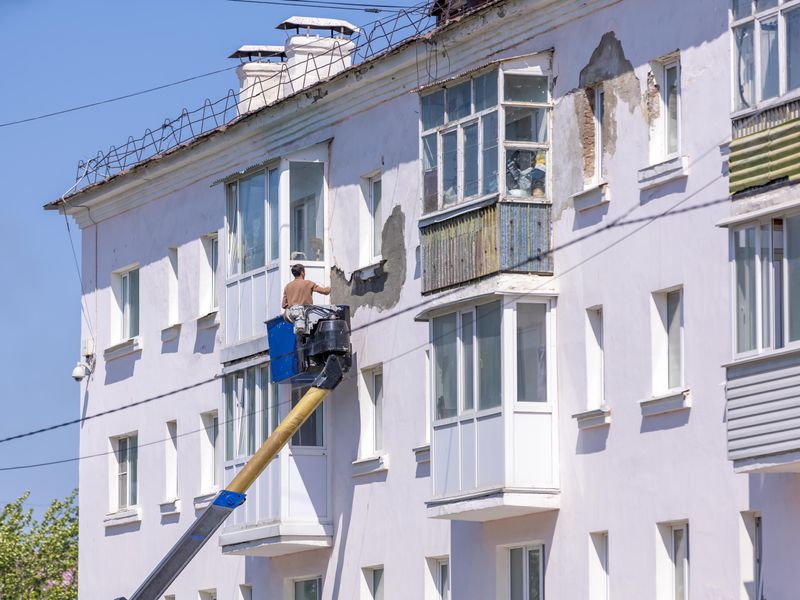
Envelope only. Render repair, coating, balcony edge detail and balustrades, in the region of €55 to €175 per m² of facade. On coastal stock this is the work that actually arrests decline, because it is water and salt reaching the reinforcement that drives the repair cycle.
Full block programme. Envelope, common areas, and the services that run through them, sequenced as one job. Where the risers are being opened anyway, rewiring runs at roughly €35 to €90 per m² and replumbing at €40 to €100 per m² of the areas affected, and an energy package of insulation, glazing and cooling plant sits at €120 to €380 per m². This is what the €3,200 to €11,000 per unit range describes at its upper end.
Side-by-side comparison
| Reactive repair | Common areas only | Envelope only | Full block programme | |
|---|---|---|---|---|
| Typical basis | Per incident | €180–560 per m² | €55–175 per m² | €3,200–11,000 per unit |
| Access paid for | Every time | Usually none | Once | Once |
| Fixes the cause of decline | No | No | Yes | Yes |
| Effect on saleability | None | Immediate, cosmetic | Slower, structural | Both |
| Effect on running costs | None | Lighting only | Marginal | Where the energy package is included |
| Disruption to residents | Repeated, unplanned | Low | Moderate, scaffold-bound | High, but once |
| Decision difficulty | Low, often one owner acts | Moderate | High | Highest |
The row that decides most of the arithmetic is access. Scaffolding is charged for erection, hire and dismantling at roughly €4 to €13 per m² per week, and it is indifferent to what is being done behind it. A block that repairs render in year one, replaces balustrades in year four and repaints in year seven pays for scaffold three times to do work that one programme would have covered once.
Which suits which property
1970s to 1990s blocks in Nicosia. Strovolos and the surrounding suburbs hold a large stock of blocks from this period, and in them the dominant renovation work is rewiring and replumbing rather than anything cosmetic. Galvanised pipe and undersized distribution boards are the failure points. A common areas refurbishment in a block of this age is money spent on the surface of a problem that is behind the wall, and it will be disturbed again within a few years when the services are finally addressed. These blocks suit the full programme, phased by riser rather than by floor.
Coastal high-rise in Limassol. Rapid high-rise development along the Limassol coast has raised demand for balcony waterproofing and facade maintenance, and on this stock the envelope is the priority by a clear margin. Balcony edge detail and the junction between the slab and the balustrade are where water enters, and once it reaches the reinforcement the repair changes category from maintenance to structural. Envelope-first is the right sequence here, with common areas following inside the same access period.
Coastal blocks in Paphos. Kato Paphos sits in salt-laden air, which is why galvanised and marine-grade fixings are standard specification rather than an upgrade there. Any comparison that prices standard fixings against marine-grade ones and calls the cheaper option better value has misread the site. Hillside blocks around Peyia carry a separate constraint: steep access roads limit crane and delivery vehicle size, so the method statement, not the material, sets the price.
Blocks with a functioning management committee and a reserve. These are the only ones for which the full programme is genuinely available, because it is the only option that needs the owners to commit capital in advance rather than approve an invoice after the fact.
Blocks with neither. Realistically, envelope-only or common-areas-only, and the choice between them should follow whether the building is losing value through decline or through appearance. If render is failing, the answer is the envelope regardless of how the lobby looks.
Cost over ten years
Comparing these options on the day-one price gives the wrong answer, because three of the four leave the underlying condition unchanged and therefore keep spending.
Over a ten-year horizon, the variables that actually decide the total are:
- How many times access is paid for. As above, this is the largest recoverable saving in the whole comparison, and the one entirely within the owners' control. Sequencing facade, balustrades, waterproofing and any roof work into a single scaffold period is the single most effective cost decision an apartment block makes.
- Whether water is still reaching the structure at year ten. Cosmetic work does not change this. Once chloride-driven corrosion is established in balcony slabs, repair costs move from the facade rate into structural repair, which is priced per element and surveyed individually.
- How much of the services work is done while the walls are open. Rewiring and replumbing carried out as standalone jobs in occupied flats include making good; carried out while a riser is already open, much of that making good is already in the programme.
- Whether the energy package was included. Insulation, glazing and cooling plant only change running costs if they are actually in scope. Where they are retrofitted later as a separate exercise, the ceilings and the scaffold both have to come back.
- What the block's reserve earns or costs. A committee that levies for a programme in advance spends differently from one that borrows or that funds each emergency by special levy.
None of that produces a single ten-year figure, and any contractor offering one is estimating the condition of a building nobody has yet opened up. What it does produce is a defensible order of work: survey, envelope and services together, then common areas within the same access, then finishes.
Common questions
Is apartment block renovation worth it in Cyprus?
For a block where the envelope is failing, yes, in the narrow sense that the alternative is a repair bill that grows rather than a cost that is avoided. For a block where only the lobby looks tired, the case is a saleability argument rather than a maintenance one, and it should be made as such to the owners rather than dressed up as urgent.
Who decides, and how is the cost split?
Work to common parts is a joint decision of the owners, taken through the management committee, and the cost is apportioned across units by registered share rather than by floor area or by who benefits most. The registered shares are held by the Department of Lands and Surveys, and any programme should start by confirming them, because disputes about apportionment surface after the work is committed rather than before.
Should the block appoint its own engineer?
For anything involving the envelope, the structure or the services, yes. A qualified civil engineer or architect registered with ETEK, appointed by the committee rather than by the contractor, is what turns a set of quotes into comparable tenders. Without one, the owners are comparing documents written by different people to describe different scopes.
Can the work be done while residents stay in the flats?
Almost always, and that is one of the reasons apartment block programmes differ from hotel refurbishment, where closing is an option. Phasing by riser keeps disruption to one vertical stack at a time and keeps water and power outages short and scheduled. It costs more in programme length than a vacant building would, and it is still the normal approach.
How long should the works take?
That is set by the number of risers, the scaffold sequence around the building, and how much of the specification depends on long-lead items such as aluminium glazing units. Ask for the programme broken down by riser or elevation rather than as a single completion date, because that is the level at which slippage becomes visible early enough to act on.
What should be surveyed before quoting?
Balcony slab edges and balustrade fixings, the condition of render at the junctions rather than in the middle of panels, the electrical distribution boards, and a sample opening of the pipework. On any block where subsidence has been recorded locally, a structural survey should come before any budget is circulated to the owners.
Sources
- Department of Lands and Surveys — joint ownership and registered shares — retrieved 2026-07-29
- Cyprus Scientific and Technical Chamber (ETEK) — retrieved 2026-07-29
- Cyprus Statistical Service — construction cost and price indices — retrieved 2026-07-29
01More on this topic
Same cluster.Different question.
Where to go next
Companies, districts and the rest of the guides on this subject.
Thinking of doing this?Get up to five quotes, free.
Tell us about the property and we will gather quotes from contractors who plan around the season.